
Brass Jewelry Manufacturing: Why Plating Does the Work
On a brass piece the alloy underneath is a structure, not a look — the finish is built on top of it. Eight factory steps run from concept design to delivery, and the plating tank sits at step six, after prototyping, sprue cutting, polishing and surface art. The MOQ for artisan eco-brass is 100 pieces per design.
Key takeaways
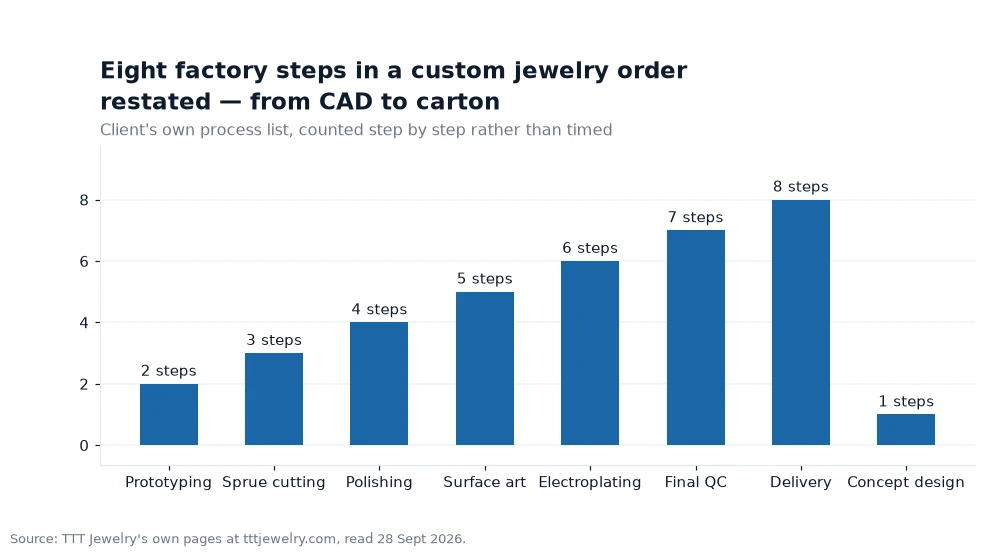
- Eight published steps run concept design, prototyping, sprue cutting, polishing, surface art, electroplating, final QC and delivery.
- Electroplating is step six, so everything the finish relies on happens before it.
- Multi-layer plating in 14K, 18K or 24K gold or rhodium, and brass carries an anti-tarnish e-coating.
- The MOQ is 100 pieces per design for artisan eco-brass, against 50 for sterling silver.
Brass is a surface as much as a material
Plated brass is judged by the coating, and the coating is judged by what it sits on. A scratch in the base metal telegraphs through a thin plate; a polished surface carries the same plate evenly. That is why the steps before electroplating are not preparation chores but the finish itself.
The published sequence makes this explicit. Polishing is described as a high-gloss finish, and surface art covers the brushed and textured work. Both happen before the plating tank, which means a decision about the look is really a decision about the bench work upstream.
The five steps that decide how the plating lands
Concept design starts it, in hand drawing and CAD. Prototyping follows, by mould or 3D printing. Then sprue cutting, which separates the castings from the feed channels and leaves the marks that polishing has to remove. Polishing creates the base gloss. Surface art adds the brushed or textured finish where the design calls for one.
Only then does electroplating deposit the coating. Read in that order, a brass piece is five steps of surface preparation followed by one step of colour, and a defect introduced at step three is still visible at step six.
Why the stack is multi-layer
The published finishes are multi-layer precious metal electroplating in 14K, 18K or 24K gold, plus rhodium. Multi-layer means exactly what it says: successive deposits rather than a single flash, which is how a plated piece is meant to hold its appearance.
Karats behave differently on brass. A 24K layer reads the warmest and is the softest of the three; 18K sits between; rhodium takes the piece into a white finish family entirely. Because the base metal is hidden by the coating, the karat is a purely visual decision on a brass piece — and it is the decision buyers ask about first.
What the anti-tarnish e-coating adds
Brass and silver pieces both take an anti-tarnish e-coating over the plating, which is a protective pass rather than a thicker plate. It is the top layer of the stack and the one in contact with the outside world.
That matters for handling as well as wear. A coated piece is easier to pack, store and ship without the finish dulling in the pouch, which is why packaging follows the plating step in the published sequence and not before it.
Inspection after plating, and what it cannot catch
Final QC is step seven, after electroplating, and is published as a 100% inspection before delivery. Sitting after the coating is deliberate: a plated piece can pass a visual check on the bench and still be wrong, so the check has to see the finished surface.
What inspection cannot do is recover a decision made at step one. A chain spec, a stone seat or a hallmark placement approved by default will pass every downstream check while still being the wrong instruction.
| Step | What it does | Why the finish depends on it |
|---|---|---|
| Concept design | Hand drawing and CAD | Sets the geometry the casting copies |
| Prototyping | Mould or 3D printing | Fixes wall thickness and relief detail |
| Sprue cutting | Separates castings from feed channels | Leaves marks that polishing must clear |
| Polishing | High-gloss finish | A smooth base plate reads evenly |
| Electroplating | Multi-layer gold or rhodium deposit | The colour layer itself |
What the brass line publishes on its own page
The brass product page describes the alloy as a premium alloy of copper and zinc, states that nickel content meets certified standards, and confirms compliance with REACH and California Proposition 65. It also carries a sustainability line worth quoting: the brass is 100% recyclable.
Finish options there go past karat choice. Advanced gold and rhodium plating layers are described as forming a durable barrier that is suitable and comfortable for most skin types, and oxidation or antique finishes are offered for designs that want an aged surface rather than a bright one. Either route still ends in the same place: a coating sitting on polished metal.
A brand briefing a custom brass jewelry manufacturer can compare two published views of the work. The brass line publishes a six-step flow — requirement confirmation, CAD design and the precision mould, prototyping with hand polishing, high-standard electroplating with anti-tarnish, sample confirmation, and a 100% manual check of craft, finish, gem setting, size and structure. The factory sequence charted further down splits the same territory into eight steps and treats polishing and surface art separately. Both are useful; neither is a substitute for reading the drawing.
Worked example: six of eight steps happen before the tank
Number the published steps one to eight and electroplating is step six. So 6 ÷ 8 = 75% of the process runs before the coating is applied. On a 100-piece minimum order for artisan eco-brass, that is 75 of every 100 pieces' worth of work already committed by the time the plating tank is reached.
Turn it around and the number becomes a warning. A problem that can only be seen after plating — uneven colour, a dull patch, an uncoated edge — invalidates work that was carried through the first 75% of the sequence, and the rework starts at the polishing wheel rather than at the tank.
That is the argument for inspecting the base surface before plating rather than only the finished piece, and it is why the published order puts surface art ahead of electroplating rather than the other way round.
Frequently asked questions
How is a brass piece plated?
By multi-layer precious metal electroplating in 14K, 18K or 24K gold or rhodium, followed by an anti-tarnish e-coating on the finished piece.
Why does polishing come before plating?
Because the coating copies the surface underneath it. A high-gloss base carries an even plate, and sprue marks left unpolished show through the finish.
What is the MOQ for plated brass work?
100 pieces per design in artisan eco-brass; 925 sterling silver starts at 50 pieces per design and stainless steel at 100+.
Planning a plated range from the back of the process
Start at step eight and work backwards: delivery, inspection, plating, surface art, polishing, sprue cutting, prototyping, design. Deciding the finish first tells you what the bench work has to achieve, which is more useful than choosing a look and hoping the workshop interprets it. Brands sourcing a plated line can read how the custom jewelry wholesale page frames a first order, and check the sequence against the factory page before tooling is booked.
Where the numbers come from — the REACH and California Prop 65 compliance as well as the six customisation options as well as the 100% recyclable brass claim — is the supplier's own site on tttjewelry.com's own pages, which I read through on 28 Sept 2026. The sums that follow from those inputs are my own arithmetic, while the source figures stay the client's[1].